
By Mathilde Sudan, EyeTeK · Published 13 October 2026 · 7 min read
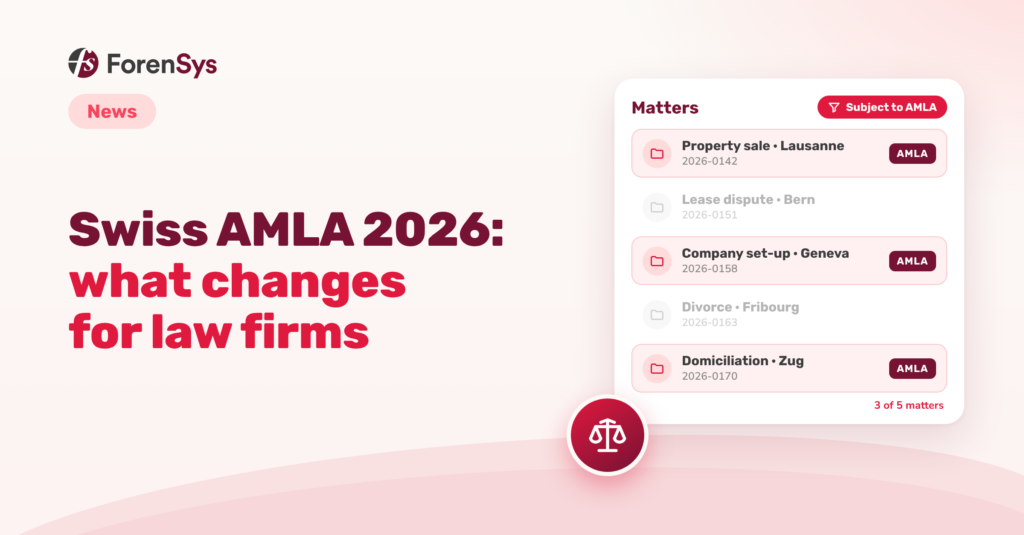
Since 1 October 2026, the revised Anti-Money Laundering Act (AMLA) and the new Federal Act on the Transparency of Legal Entities have been in force in Switzerland. For the first time, certain advisory activities carried out by lawyers, notaries and fiduciaries fall within the scope of the AMLA, even when no funds pass through the firm. To help you find your way, ForenSys lets you flag your matters with a tag, such as “Subject to AMLA”. Here is first how ForenSys helps you identify these files, followed by the essentials of the new act, explained simply.
💡 In a nutshell
- In ForenSys, a “Subject to AMLA” tag lets you flag and filter the matters concerned.
- Since 1 October 2026: revised AMLA and new Transparency Act.
- A non-public federal register lists the people who actually control companies.
- Certain advisory activities are now subject to the AMLA: real estate, setting up and managing companies with no operational activity, providing a domicile.
- What counts is the activity carried out in the matter, not the profession.
What changes in ForenSys: the “Subject to AMLA” tag
Under the new AMLA, a single firm can handle matters subject to the act alongside others that are not. The essential first step: knowing which ones. Our job is not legal advice, but giving firms a reliable tool that keeps pace with the Swiss legal framework. Our response is simple and immediately useful: a tag you add freely to your matters.
Spot and filter the matters concerned
In ForenSys, you can now flag a matter with a “Subject to AMLA” tag. The tag is not applied automatically: the firm adds it freely to the matters it considers concerned. It lets you:
- Spot the files concerned at a glance, directly in matter management.
- Filter and find all tagged matters in a few clicks, for example to prepare for an SRO audit.
- Share the same information with the whole team, partners, associates and assistants, with no separate spreadsheet.
A framework already built for rigour
The tag builds on what ForenSys already does every day:
- Management of matters, clients and contacts, with conflict-of-interest checks.
- AI-assisted filing of documents and e-mails in each matter (ForenSys Business), so that a file’s records are easy to find.
- Data that stays in Switzerland: developed, hosted, audited and operated in Switzerland, in a certified data centre (ISO 27001, SOC 2 Type II), compliant with the Swiss Federal Act on Data Protection. Our AI models also run on Swiss servers.
⚖️ The AMLA tag helps you organise and identify files. It does not replace the legal analysis of each matter or the due diligence obligations, which remain the firm’s responsibility.
To make good use of the tag, you first need to know which matters are concerned. Here are the essentials of the new AMLA, explained simply.
Why is the AMLA changing now?
The fight against money laundering is based on international standards set by the FATF (Financial Action Task Force). Switzerland will be assessed again in 2027/2028. Previous assessments highlighted two weaknesses: a lack of transparency about the real owners of companies, and advisors who set up structures without handling funds themselves, and were therefore not subject to due diligence obligations.
Parliament therefore adopted two acts on 26 September 2025: the AMLA revision and the new Transparency Act. The Federal Council set their entry into force, together with their ordinances, for 1 October 2026.
Key terms in 30 seconds
- AMLA: Federal Act on Combating Money Laundering and Terrorist Financing.
- Beneficial owner: the natural person who actually controls a company or benefits from it.
- Subject to the AMLA: professionals who must comply with the AMLA due diligence obligations.
- SRO: self-regulatory organisation. Professionals subject to the AMLA join one and are supervised by it.
- MROS: Money Laundering Reporting Office Switzerland, to which suspicions are reported.
Change no. 1: a federal register of beneficial owners
A transparency register, kept by the Federal Office of Justice, now records the natural persons who ultimately control Swiss legal entities, including companies limited by shares, limited liability companies, cooperatives, foundations and associations entered in the commercial register. These entities must declare and keep this information up to date.
Unlike the commercial register, this register is not public. It can be consulted by criminal prosecution authorities, MROS and professionals subject to the AMLA, who can use it to check their own information. Transitional periods for registering existing entities have been running since 1 October 2026.
For your firm: your corporate clients will ask you about their reporting obligations. If you are subject to the AMLA yourself, the register becomes an additional verification tool.
Change no. 2: certain advisory activities now subject to the AMLA
This is the most significant change for the legal professions. Until now, a lawyer or notary was only subject to the AMLA when acting as a financial intermediary, for example when managing client funds. From now on, certain high-risk advisory activities are covered, even without handling money:
- the purchase or sale of real estate;
- setting up, running or managing companies with no operational activity (domiciliary companies), as well as contributions, distributions or sales made through them;
- providing an address or premises as a registered office or domicile for more than six months.
Two further conditions apply: the advice must make an essential contribution to the transaction, and it must be provided on a professional basis. The revised ordinance sets thresholds for this, based in particular on the income from these activities, the number of clients or the transaction volume. Exceptions exist, for example for certain family or inheritance-related transactions.
The key point: it is not the title that matters, but the actual activity carried out in each matter. A single firm can therefore handle matters subject to the AMLA alongside others that are not.
What does not change
- General legal advice and representation in court remain outside the scope of the AMLA.
- Professional secrecy continues to protect the typical activities of lawyers, defence in particular. Pure structuring advice, however, is not systematically covered.
- For state notarial offices, the new provisions are postponed until the cantons have adapted their legislation.
What it means for a firm concerned
For the matters covered, the firm takes on the obligations of a professional subject to the AMLA:
- Join a recognised self-regulatory organisation (SRO), which will audit it periodically.
- Identify the client and the beneficial owner, and understand the economic background of the transaction.
- Document in a traceable, risk-based way, and keep records for ten years.
- Report well-founded suspicions to MROS.
- Set up internal guidelines and train staff.
All of this depends on one prerequisite: knowing exactly which files are concerned. And that is often where things get complicated, between Excel lists, partners’ memories and paper files. This is exactly what the “Subject to AMLA” tag presented above is for.
Where to start? 4 simple steps
- Review your portfolio: which matters involve a covered activity (real estate, companies with no operational activity, domiciliation)?
- Tag these matters in ForenSys for a clear, up-to-date overview.
- Contact your SRO to find out the membership and documentation requirements.
- Inform your corporate clients of their obligation to report to the transparency register.
FAQ: the new AMLA in questions
Is my firm automatically subject to the AMLA?
No. What counts is the activity carried out in each matter. Only certain advisory activities, provided on a professional basis, are covered.
Which advisory activities are concerned?
Mainly the purchase or sale of real estate, setting up, running or managing companies with no operational activity, and providing a domicile or registered office for more than six months.
Who has access to the transparency register?
It is not public. It is accessible to criminal prosecution authorities, MROS and professionals subject to the AMLA.
Are notaries concerned?
Independent notaries are, for the activities covered. For state notarial offices, application is postponed until cantonal law has been adapted.
Does the ForenSys AMLA tag make my firm compliant?
No. It is an organisational tool that helps you identify and track the matters concerned. Compliance relies on the analysis of each matter and on meeting due diligence obligations.
Where can I find the official texts?
On the Swiss federal government website: Federal Council press release of 12 June 2026 and transparency register.
Want to see the AMLA tag in action? Book your demo at eyetek.ch/contact.
About the author: Mathilde Sudan is Marketing & Customer Success Manager at EyeTeK, publisher of ForenSys, the digital cockpit for Swiss legal professionals, used by more than 600 firms in Switzerland.
This article is for general information purposes only and does not constitute legal advice.

